Place8′
Traditional Baked Goods at Fyllo
Zurich now has its own family-run bakery that makes handmade phyllo dough

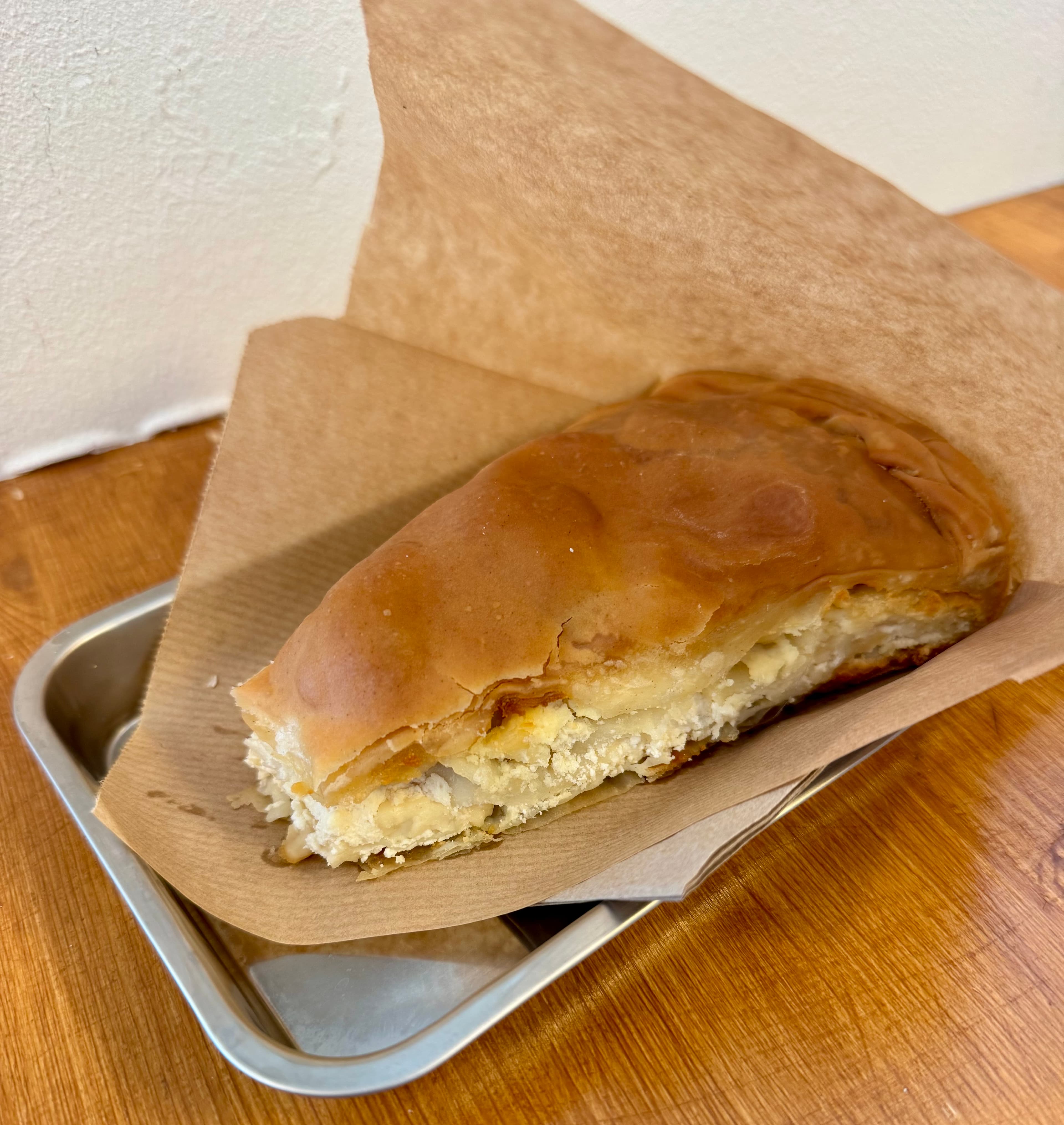
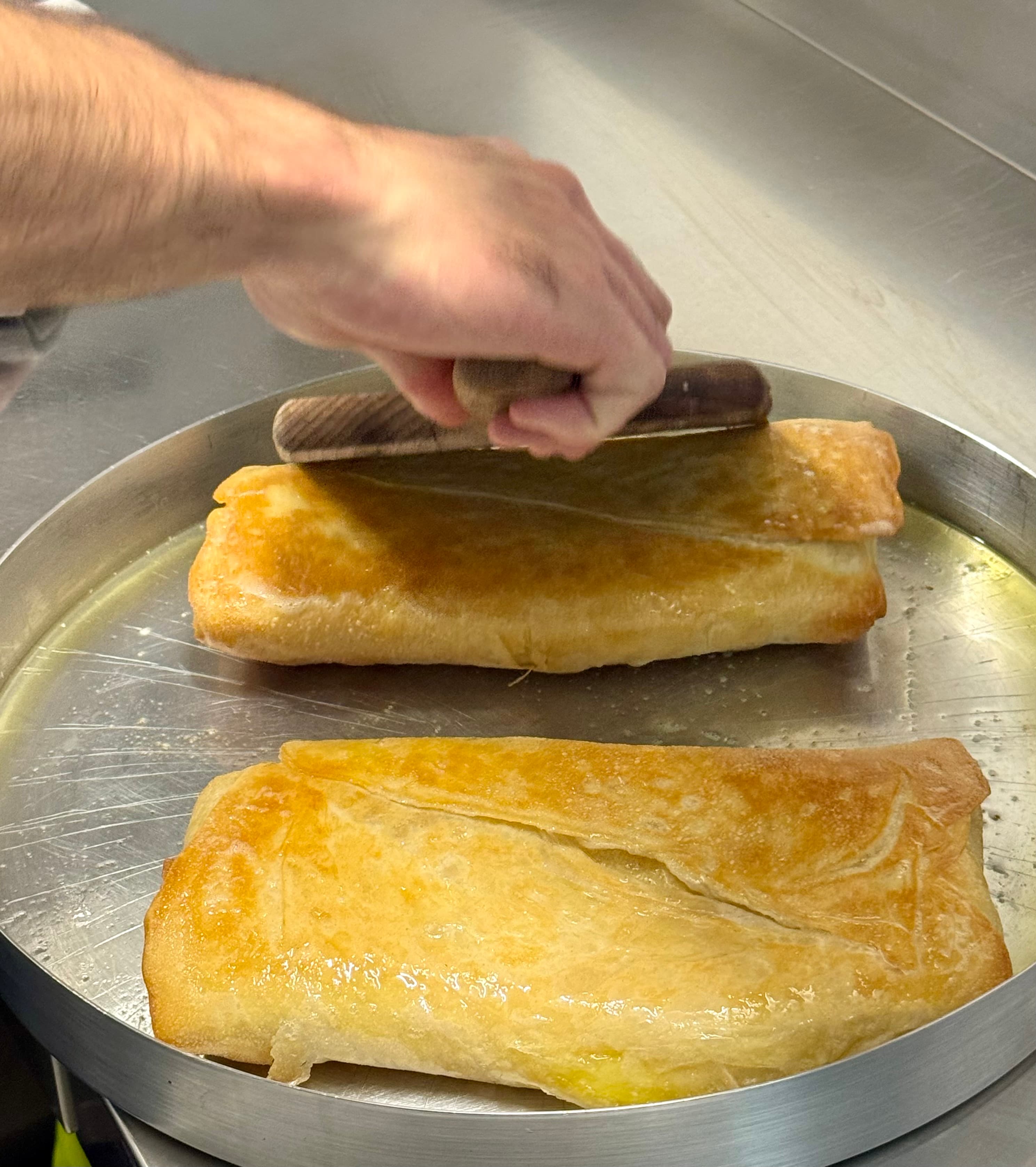
Giorgos turning his handmade bougatsa, which has just come out of the oven.
20 October 2026

Zurich now has its own family-run bakery that makes handmade phyllo dough
Giorgos turning his handmade bougatsa, which has just come out of the oven.
Neighborhoods always derive their character from the shops that line their streets and the people who have established them, shaping the habits of their residents. One such shop is Fyllo, the first Greek bakery in Zurich, located in the Unterstrass neighborhood, where they knead dough every morning. This is the story of Vaso and Giorgos, two siblings who are bringing their father’s traditional recipes to the city.
Very often, great stories in gastronomy begin with tradition, but more and more frequently they spring from everyday life at a multinational company. Vaso found herself working for a multinational company in Zurich with operations in Asia. She enjoyed the human side of the job. She traveled to Asia, got to know the people there—who even invited her into their homes—and everything was wonderful. Until, in her second year, she realized something was missing. “I’d go to the office and think, ‘OK, back to the computer again.’” Around that time, her dad and brother came to visit her in Zurich. As they walked around the city, they talked about how there wasn’t a Greek bakery.
A year later, Vaso told her partner, Konstantinos, that she would like to open a place that served Greek baked goods in the city. When she shared the same idea with her father, who owns a bakery in Greece, he hesitated. Where would they even start in a foreign country? Meanwhile, her brother Giorgos had been thinking about starting his own business while working for the season in Mykonos because he was tired of the working conditions.
And at some point there, I said to Konstantinos, “You know what? We need to start looking for a store. It’s now or never.”
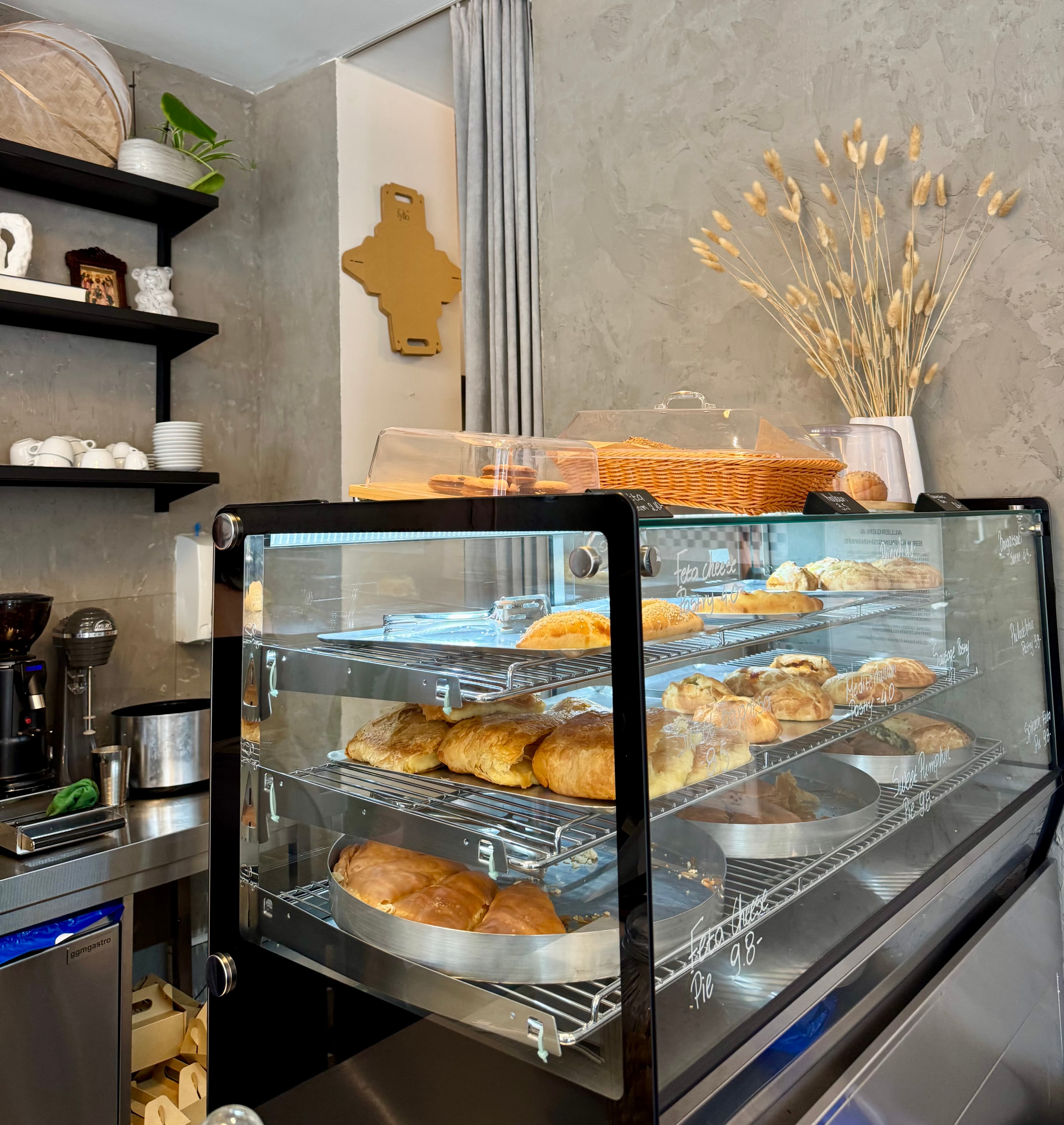
I came by this place one Saturday and ate almost everything in the display case. It was my first time at Fyllo, but I felt right at home. Simply because what they offer is authentic. When the shop became available for rent, Vaso and Konstantinos were in the queue along with 30 other people. They just showed up out of nowhere with their first crazy business idea. That’s when they had to play their last card to secure the shop, especially in a market as demanding as Zurich’s. In the end, the solution was the concept itself.
Just think. We went to Greece, brought back a pie, and Konstantinos gave it to the man who was renting out the shop.
As Vaso admits, opening the bakery was a traumatic experience because she didn’t know where to start. But as she heard more about her father’s journey, she realized that whatever they were going through couldn’t compare to what he had experienced. Their father is the youngest of three brothers, raised in a very poor family. Her grandmother gathered ears of grain and cotton in the fields, while her grandfather worked in the fields and tended sheep. He used to tell his children that when they came home, there wasn’t always enough bread to go around. As a teenager, he collected hair from barbershops to earn pocket money. Before he had even come of age, while he was picking olives with his family, he put down his hoe and said he couldn’t take it anymore. He set off on his own for Athens. First, he worked as a dishwasher and learned the ropes, and then, in Omonia, he gradually learned from a mentor how all the products are made. Whenever he passes through Athens, he still visits him, as a way of saying a big thank you. Then he returned home and opened his own bakery.
The children grew up in the bakery. Vaso would chop spinach and grate the kasseri (κασέρι) cheese that went on top of the pastry, and later she also helped with sales. But not out of necessity. Their father never asked them to go. Giorgos started working in the workshop at age 13, washing dishes. “Dishwashing is the greatest school,” his father used to say, because that’s where you learn to respect every job: if you can get one basin dirty instead of two, you’ll do it. Every Easter, when he was 14, he washed 70 to 80 baking pans filled with spinach pies and cheese pies.
Giorgos, who is now 24 and works at the bakery from morning till night, seven days a week, also told me about the recipes behind everything made at Fyllo. His father makes kourou (κουρού) dough, cheese pies, the classics. His own dough is similar to kourou but leans toward brioche due to the flours he uses, and he’s adapted it to Zurich and the locals’ tastes. The goal is for it not to be too heavy on the palate and to pair well with the filling of and feta.
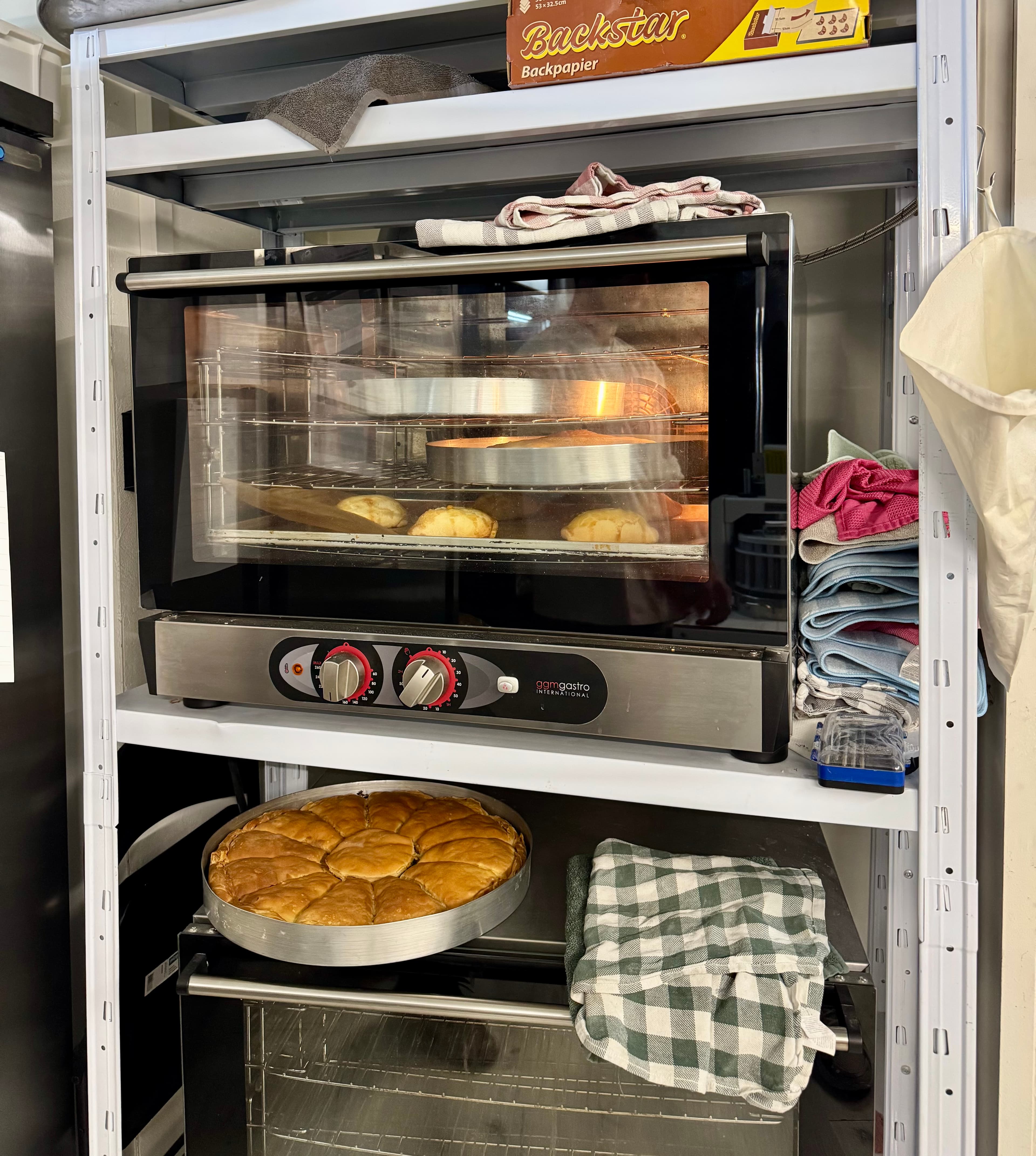
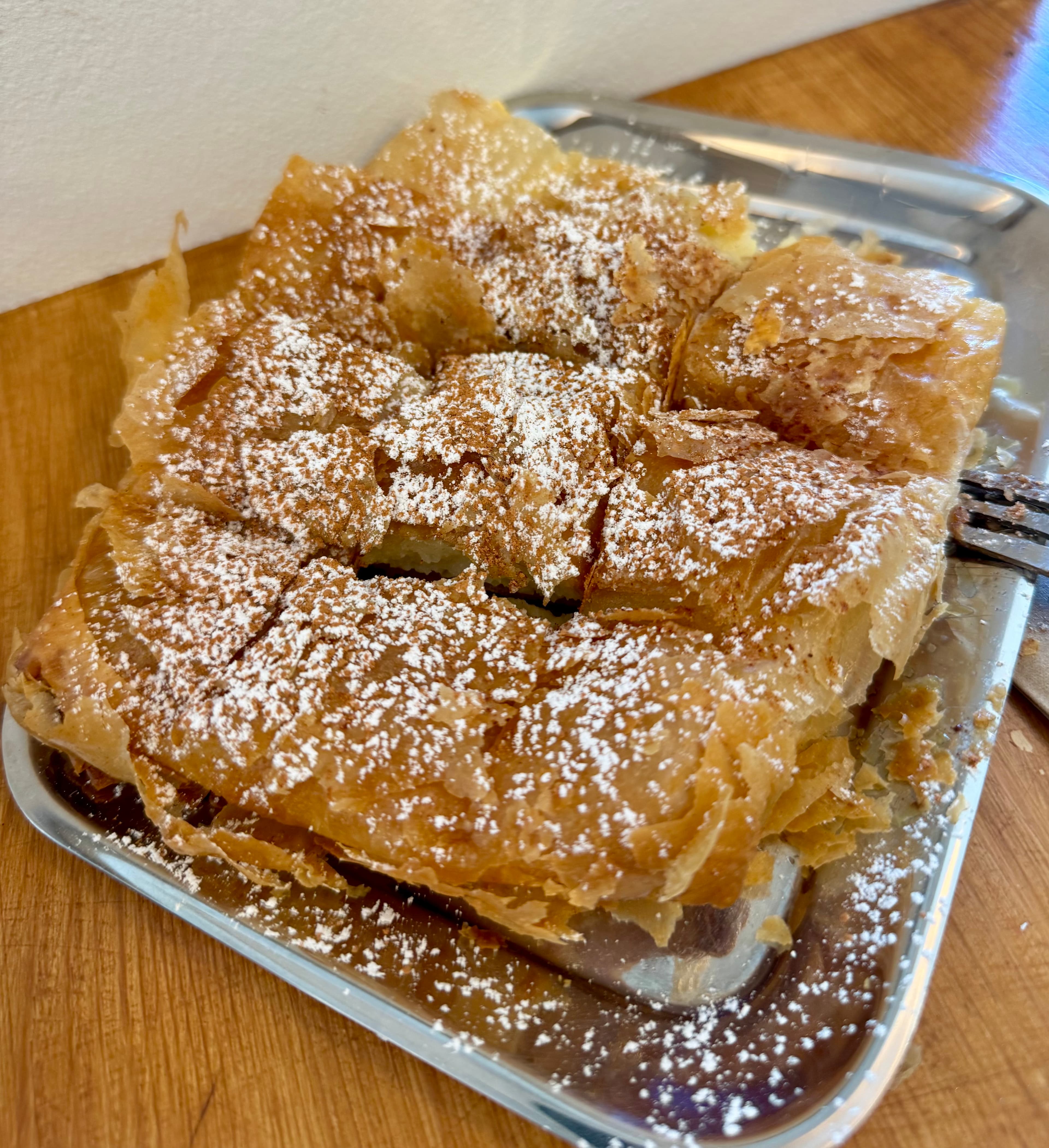
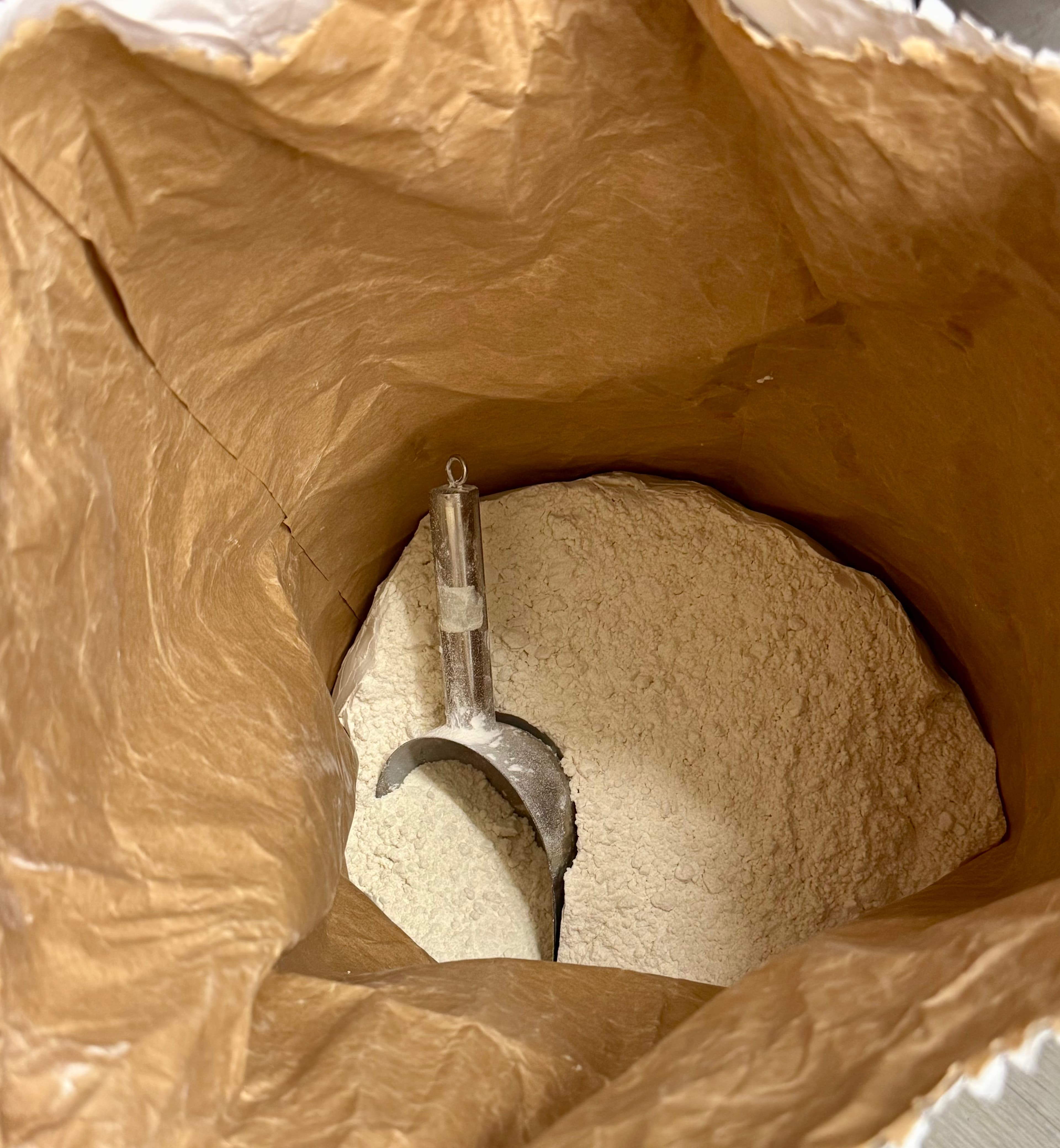
Bougatsa is the most labor-intensive item in the bakery. The dough is kneaded the day before and left to rest in the refrigerator. The next day, it is taken out to thaw, pressed to soften and relax the gluten, and then rolled out into a thin phyllo called aerofyllo (αερόφυλλο), cut, and filled with cream. For bougatsa, he uses durum wheat, while for pita, he uses soft wheat. Salt, which toughens the dough, plays a role, and so does the weather: when it’s cold, the dough needs to be softer so it can be rolled out. Terroir, in other words, applies to bougatsa as well.
The hard part, says Giorgos, isn’t making a good product but ensuring it turns out the same every day: Monday’s chortopita must be the same as Tuesday’s, Wednesday’s, and Saturday’s. His rule is, “If a recipe works, don’t change it.” He only makes adjustments dictated by the flours, because Switzerland doesn’t have the same varieties as Greece. At one point, he couldn’t find mizithra anywhere, so he asked their supplier to start importing it to Switzerland. The only things they bring from Greece themselves are cinnamon and cloves, in his mother’s suitcase.
You should come by one day to see what the bougatsa, the thin phyllo, is like. It’s truly magical.
I could never turn down Giorgos’ invitation. Especially after I went downstairs so he could show me his workshop, too. The smells on the upper floor were already a good indication of what to expect, but in the workshop, everything was even more intense. We were talking with Giorgos about all the work he puts into everything he makes, and even though I’d already eaten half the menu, I wanted to eat some more. Especially while he was telling me how his father showed him the phyllo turning technique using a towel.
The flavors I discovered at Fyllo are, without a doubt, the most affordable ticket to experience Greek baked goods outside of Greece.
After I went back upstairs and left the workshop and its smells behind me, I ran into Vaso again and asked her what she thought was missing from the Zurich market. She told me there are two things missing. The first is that there are no family-owned shops. If there are any, they’ve been bought out by a large corporation and are simply marketed as family-owned. The second is fresh, handmade products, items that customers can buy that aren’t frozen and were baked no more than an hour and a half ago.
The Zurich clientele, she adds, is demanding, and this is a double-edged sword: they have high standards, they recognize quality, and that’s why they keep coming back. Giorgos, on the other hand, focuses on flavor, striving to bring it out in everything he makes. In the bougatsa, the vanilla and butter must come through on the customer’s palate. Before I left, I asked both of them what they want their customers to take away with them when they leave Fyllo.
Get new posts in your inbox
No spam. Just new stories, recipes, and places, whenever they're published.
For Vaso, it’s a personal matter. She wants people to understand that it’s not just a bakery. It’s not just four walls where you walk in and pick up a product. You get to know the person who makes the products literally right under your feet. And essentially, people get a glimpse of who the owners really are. It’s part of that “I want to know who you are” feeling. It’s their love, passion, and hospitality; things that words can’t fully capture. For Giorgos, what matters is that people visit not only to eat the specific pastries they’ll find at Fyllo, but also to enjoy the experience of savoring them.
I want you to remember it. That’s what matters. Sure, the taste and everything else, the overall result, but I want all of that to stay in your subconscious.
For me, that first visit felt incomplete because I wasn’t able to try everything. A few weeks later, I went back with reinforcements to try everything I’d missed from the menu. I think Fyllo’s greatest success is that the two siblings have achieved exactly what they set out to do. I can’t wait to see what comes next.
Zurich, Switzerland
Schaffhauserstrasse 6, 8006 Zurich, Switzerland
A family-owned bakery in Unterstrass that makes handmade phyllo dough and a wide variety of baked goods.
Each recipe has its own journey. The small pies, the cheese pie, the sausage pie, and the Philadelphia pie are all made from a dough that his father learned from a refugee from İzmir. The bougatsa (μπουγάτσα), its phyllo, and its filling are recipes based on the Thessaloniki style. His father learned how to make the chortopita (χορτόπιτα) in Athens from someone who made puff pastries, and he added his touch with the flavors of his homeland. Giorgos created the tsoureki (τσουρέκι) and cookies recipes on his own.